
The miracle fat?
From brain energy to metabolism: why MCT is about much more than keto.
Neo Leaf Editorial · 14 November 2026 · 8 min read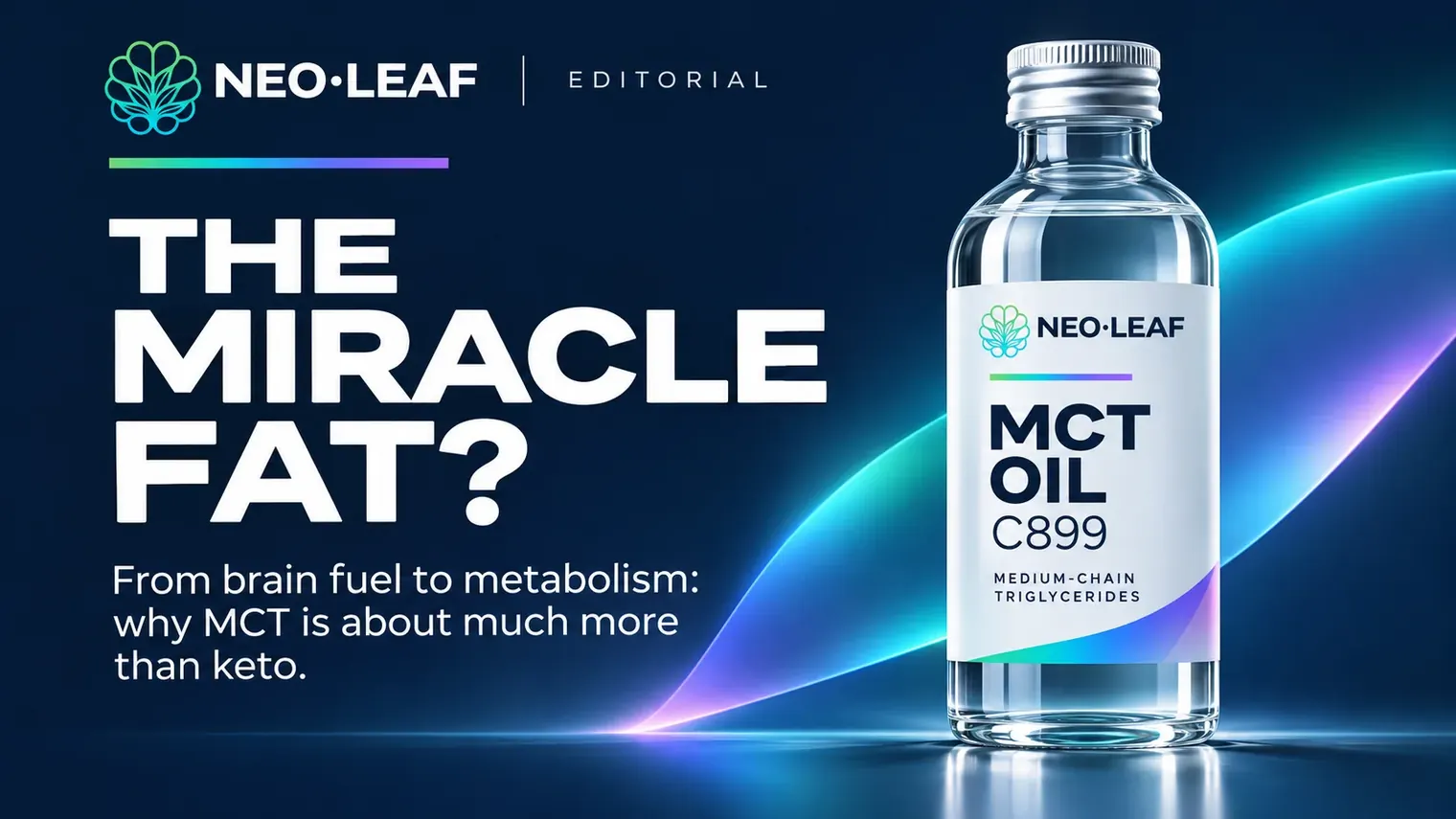
Medium-chain triglycerides are fundamentally different from most of the fats we eat. They are absorbed differently, transported differently and used differently by the body, and that distinction is the reason MCT has attracted decades of scientific interest across nutrition, metabolism and human health.
Written for formulators and buyers in nutrition, supplements and pet food. A summary of published research, not medical advice.
For many consumers, however, MCT oil is still closely associated with one thing: keto. That connection makes sense. MCTs, and particularly the C8 fatty acid caprylic acid, can be rapidly metabolized in the liver and contribute to the production of ketones. But reducing MCT to a ketogenic-diet ingredient misses much of what makes it interesting. Long before MCT became a familiar addition to coffee and low-carbohydrate diets, it was already being used in clinical nutrition because of the way the body digests and absorbs it. Researchers have since explored its role in brain energy, cognitive function, energy expenditure, body composition, exercise and other areas of nutritional science.
What links all of these areas is not a trend. It is metabolism.
A fat that takes a different route
Most dietary fats are made primarily from long-chain fatty acids. After digestion, they are packaged and transported through the lymphatic system before entering the wider circulation. Medium-chain fatty acids follow a more direct route. They are rapidly absorbed, enter the portal circulation and are transported toward the liver, where they can be oxidized relatively quickly for energy.
That difference matters because the body does not treat every calorie of fat in exactly the same way. The physical and metabolic characteristics of medium-chain fatty acids influence how quickly they become available, how readily they are oxidized and how strongly they can contribute to ketone production. This is why MCT has found applications in specialist nutrition for decades and why it continues to attract researchers interested in how nutrients influence energy metabolism.
It is also the reason the modern discussion around MCT should be broader than keto. Ketosis is one visible expression of MCT metabolism, but it is not the whole story. Once the body begins using medium-chain fatty acids, a range of metabolic effects can follow, and several of those effects are now being studied in areas that have little to do with whether someone considers themselves “keto.”
Brain energy: one of the most intriguing areas of MCT research
The brain normally relies heavily on glucose for energy, but glucose is not its only possible fuel. Ketone bodies can cross the blood-brain barrier and provide an alternative energy source for brain cells, which is one reason scientists have become interested in ketogenic metabolism in conditions where cerebral glucose use may be impaired.
This has produced particularly interesting research in people with mild cognitive impairment and Alzheimer’s disease. In one placebo-controlled study involving 20 people with Alzheimer’s disease or mild cognitive impairment, MCT consumption significantly raised levels of the ketone beta-hydroxybutyrate within 90 minutes. The researchers also observed improvements in some measures of cognitive performance, with the response differing according to participants’ APOE genotype.
The research did not stop there. A 2023 systematic review and meta-analysis examined 10 clinical studies investigating MCT and cognitive impairment. The analysis found an overall improvement in general cognitive function following MCT administration, with a stronger effect among participants who did not carry the APOE-ε4 allele. The researchers did not find significant improvement across every individual cognitive domain, and they called for better-characterized clinical studies, but the overall findings provide clear evidence that MCT and ketone metabolism remain serious areas of interest in cognitive research.
The significance of this research is not that MCT should be presented as a cure for Alzheimer’s disease. It is that human studies have reported measurable improvements in cognitive performance among some people with Alzheimer’s disease or mild cognitive impairment after MCT supplementation. That is an important distinction, and it is one of the reasons the relationship between MCT, ketones and brain energy deserves considerably more attention than it normally receives.
The body may use MCT energy differently too
The effects of MCT are not limited to ketones or the brain. Researchers have also studied what happens to energy expenditure, fat oxidation and body composition when medium-chain fats replace longer-chain fats in the diet.
In one randomized crossover study involving overweight men, participants consumed diets rich in MCTs or long-chain fats for 28 days. The MCT-rich intervention was associated with a greater reduction in upper-body adipose tissue than the comparison diet, while energy expenditure was also higher at certain measurement points. The researchers concluded that the differences may have been related to increased energy expenditure and fat oxidation associated with MCT consumption.
Other research has reported similar metabolic differences. Medium-chain fatty acids are rapidly transported to the liver and readily oxidized, and controlled dietary studies have examined their effects on thermogenesis and the accumulation of body fat. These findings do not turn MCT into a shortcut that overrides the rest of a person’s diet, but they do show why it is misleading to treat all dietary fats as metabolically identical.
For consumers interested in weight management, energy balance or metabolic health, that is a far more useful way to understand MCT. It is not simply another source of dietary fat. Its structure influences how the body processes it, and that difference can affect the way its energy is handled.
What about exercise and physical performance?
The same characteristics that make MCT interesting in metabolism have also led researchers to study its potential role in physical activity. If medium-chain fatty acids are rapidly absorbed and oxidized, could they influence how the body uses fuel during exercise?
One study in recreational athletes looked at exactly that question. Participants consumed food containing 6 grams of MCT per day for two weeks before undergoing a cycling test. During the MCT phase, time to exhaustion during the high-intensity portion of the exercise test was significantly longer, while blood lactate levels and perceived exertion were lower at certain points during exercise.
The wider exercise literature is not uniform, and the researchers themselves noted that other studies had failed to show significant performance improvements. That makes MCT an interesting area of sports-nutrition research rather than a guaranteed performance enhancer. But once again, the important point is that the metabolic behavior of MCT continues to produce effects worth investigating, from substrate utilization and energy production to fatigue and endurance.
Much more than a keto ingredient
The modern popularity of MCT has created a strange situation. Keto helped introduce millions of people to the ingredient, but it also narrowed the way many people think about it. MCT became associated with low-carbohydrate dieting when its nutritional history and scientific relevance are much broader.
MCTs were being used in clinical nutrition decades before ketogenic dieting became a consumer trend. Their absorption characteristics made them useful in specialist nutritional applications, and their ability to contribute to ketone production later opened new questions about brain energy and neurological nutrition. Research into energy expenditure and body composition added another dimension, while work in exercise metabolism continues to examine how medium-chain fats might influence the way the body uses fuel.
That broader scientific picture changes how MCT should be viewed in everyday nutrition as well. There is no requirement to follow a strict ketogenic diet before MCT becomes relevant. Oils and powders can be incorporated into coffee, shakes, nutritional drinks, functional foods and formulated supplements, allowing manufacturers to use MCT in products designed for a much wider audience than the traditional keto consumer.
For product developers, this matters. MCT can be positioned around energy, functional nutrition and metabolic characteristics rather than being locked into a single dietary category. C8-rich products can be formulated where stronger ketone production is desired, while broader MCT blends can be used across everyday nutrition, powders, beverages and other functional applications.
Why the science matters commercially
Consumers are becoming more sophisticated about nutrition. They increasingly want to know not only what an ingredient contains, but what the body actually does with it. That shift creates a natural advantage for ingredients whose function can be explained clearly and supported by research.
MCT has that story. Its shorter fatty-acid structure changes how it is absorbed and metabolized. That metabolic difference helps explain its ability to contribute to ketone production, its role as an alternative source of energy, the research into cognitive function, its effects on energy expenditure and body composition, and the continuing scientific interest in exercise and therapeutic nutrition.
For manufacturers, supplement companies and functional-food brands, the opportunity is therefore much larger than simply producing another product for the keto shelf. MCT can sit at the intersection of everyday nutrition, metabolic health, functional beverages, sports nutrition and more specialized nutritional applications.
The science will continue to develop, and not every research question has been answered. But enough is already known to make one thing clear: MCT deserves to be understood on its own terms, not simply as an accessory to a diet trend.
Keto made MCT famous. The metabolism of MCT is what makes it valuable.
And that is why this so-called “miracle fat” is likely to remain one of the most interesting functional ingredients in nutrition for years to come.
Sources (5)
- Reger MA, Henderson ST, Hale C, et al. Effects of β-hydroxybutyrate on cognition in memory-impaired adults. Neurobiology of Aging 25 (2004) 311–314.
- Sun L, Ye KX, Wong HLK, et al. The effects of medium chain triglyceride for Alzheimer's disease related cognitive impairment: a systematic review and meta-analysis. Journal of Alzheimer's Disease 94 (2023) 441–456. doi:10.3233/JAD-230406
- St-Onge MP, Ross R, Parsons WD, Jones PJH. Medium-chain triglycerides increase energy expenditure and decrease adiposity in overweight men. Obesity Research 11 (2003) 395–402.
- Takeuchi H, Sekine S, Kojima K, Aoyama T. The application of medium-chain fatty acids: edible oil with a suppressing effect on body fat accumulation. Asia Pacific Journal of Clinical Nutrition 17 (S1) (2008) 320–323.
- Nosaka N, Suzuki Y, Nagatoishi A, et al. Effect of ingestion of medium-chain triacylglycerols on moderate- and high-intensity exercise in recreational athletes. Journal of Nutritional Science and Vitaminology 55 (2009) 120–125. doi:10.3177/jnsv.55.120
Talk to a person.
Tell us the product, the quantity and where it's going. Someone on our team replies, not a ticket system.